How Outdated Legacy Systems Are Holding Your Business Back and Why Custom Software Solutions Are the Only Way Forward
There is a company I heard about a while back. Mid-sized. Around 400 employees. They had been running the same internal software since 2009. Same interface. Same limitations. When they finally sat down to count what that decision had been costing them, the number was somewhere in the range of 60 to 70 hours of staff time wasted every single week. Not because people were lazy. Because the system made simple things unnecessarily hard.
That story is not unusual. In fact it is probably closer to the norm than most business owners would like to admit.
The problem with legacy systems is not that they are old
People assume the issue is age. It is not really about age. The real problem is that old systems were built for a version of your business that no longer exists. Your team is bigger now, or different. Your processes have changed. Your customers expect more. But the software is still behaving like it is 2009.
And because replacing it feels expensive and disruptive, most companies just keep patching. Add a plugin here. Build a workaround there. At some point the whole thing becomes a patchwork that nobody fully understands, and onboarding a new employee means three weeks of explaining why things work the way they do.
That is not a technology problem. That is a business problem.
Where the real cost hides
Most of the damage from outdated systems does not show up on any invoice. It hides in slower decisions because pulling a report takes four manual steps instead of one. It hides in duplicate data entry because System A and System B do not talk to each other. It hides in security gaps that your IT team quietly worries about but has not had the budget to properly address.
In industries like healthcare software development the stakes are even higher. A system that cannot integrate with new diagnostic tools or patient management platforms is not just inefficient. It creates compliance risk and directly affects care quality. The cost of doing nothing there is not abstract at all.
Why off-the-shelf software is not the answer either
At some point, most companies try to solve this by buying a commercial solution. And sometimes that works fine for basic needs. But generic software is built for the average business. Yours is not average. Your workflows, your data structure, your reporting needs, your integrations are specific to you.
What ends up happening is that you spend months configuring the software to fit your processes. Then you realize it cannot do three things that your old system actually could do. So you build workarounds again. And now you are back in the same situation, just with a shinier interface and a higher annual license fee.
This is exactly where companies start looking seriously at custom software development companies in India and other markets that offer serious engineering capability at realistic cost structures.
What custom software actually changes
When software is built around your actual operations rather than a general idea of what operations look like, the difference shows up quickly.
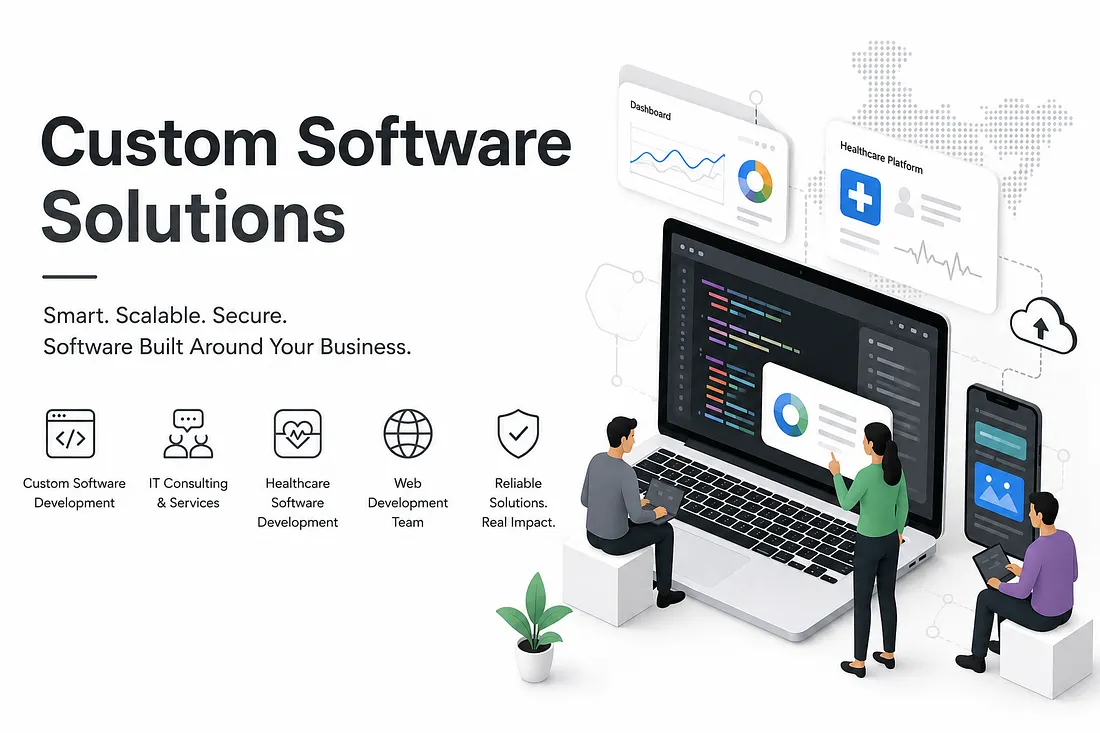
Your web development team or your software partner builds around your exact process flow. Integrations work the way your team works. Reports surface the data your managers actually need. And because you are not paying for features you will never use, the system stays clean and fast.
More importantly, it grows with you. You can add a module when your business expands into a new service area. You can change the logic when a regulation shifts. You are not waiting for a vendor to include your feature in a future release that may or may not show up.
For businesses looking at IT consulting and services to help them through this kind of transition, the value is not just in the code delivered. It is in having someone who understands your business well enough to ask the right questions before writing a single line.
What the process looks like when it is done right
This is where a lot of companies have been burned before. They hired a team, explained what they needed, got something that did not quite fit, and then spent more money fixing it. That experience makes people gun-shy.
The difference usually comes down to the discovery phase. Any serious custom software solutions partner should be spending significant time understanding your current system, your pain points, where your people lose time, what your future plans look like. If someone is quoting you a price before they have asked those questions, that is a red flag worth paying attention to.
Cuneiform Consulting works this way. The discovery phase is not a formality. It is where the actual work of getting it right begins. By the time development starts, both sides have a clear picture of what success looks like.
A note on healthcare specifically
Healthcare software development deserves its own mention because the constraints are different. HIPAA compliance, interoperability requirements, the need to integrate with existing clinical systems, these are not features you can bolt on at the end. They have to be built in from the beginning by people who have done it before.
Generic platforms often struggle here because they were not designed with the specific security and data handling requirements that healthcare demands. A custom-built solution, done by a team with real experience in the sector, is often not just the better option but the only practical one.
So what should you actually do next
If you are reading this and recognizing your own business in any of it, the first step is not to immediately budget for a full rebuild. The first step is an honest audit. Map out where your current system causes friction. Where do people use spreadsheets because the software cannot do what they need? Where do things get manually re-entered? Where do you avoid a report because pulling it is too painful?
That audit usually makes the decision pretty clear.
And if you want a second set of eyes on it, the team at Cuneiform Consulting has been doing exactly this kind of work for businesses across multiple sectors. The conversation is worth having even if you are not sure you are ready to move yet.
Because the cost of waiting is real, even when it does not feel that way right now.
Comments
Post a Comment